
between voltage, current, and resistance. There is,
and it is a very precise one too.
It's called Ohm's Law.
|
|
We have mentioned that there is a relation
between voltage, current, and resistance. There is, and it is a very precise one too. It's called Ohm's Law. |
|
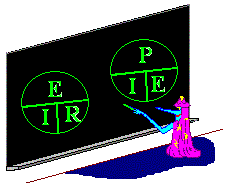
On the blackboard you see two charts.
The letters on the charts represent the electricity terms we have been discussing. They are:
E - is the electromotive force measured in Volts
|
The amazing thing is that if we know any two of the values, we can calculate the
Look at the first chart. Suppose we know that the voltage is 10 volts and the current
Now suppose we need to know how many Watts the circuit is dissipating. Look at the
There are a couple tricky ones, like suppose you have I and R and want to find P.
And now you see Ohm's Law at work!
others for any circuit. Just notice the position of each letter on the charts.
is 2 amps. We see the E is over the I, so we know to divide I into E. In this case it is
10 divided by 2. That makes 5 Ohms. That is the resistance of that circuit.
other chart. On the bottom we see I and E. Since they are side by side we multiply the
values together. 10 volts times 2 amps = 20 Watts.
Then you would take the I from each chart, since it appears on the bottom twice, and
"square" it, that is multiply it times itself. Next take the result and multiply
it times the resistance R since it, too, is on the bottom of the second chart.
When you do that, it becomes I times I times R = Power in Watts.