
Well let's get our shovels.... No forget the shovels....
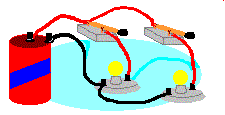
Let's look at our Parallel Circuit from the last page.
|
|
So you want to dig a little deeper into the makings of the Parallel circuit...
Well let's get our shovels.... No forget the shovels.... Let's look at our Parallel Circuit from the last page. |
|
We saw that when we connected the lights in
parallel that both could be bright, not dim like they were when we connected them in series. That was because unlike the series circuit, the full battery voltage was connected across each light bulb. |
|
So each bulb has to have the full 1.5 Volts applied to it to satisfy Kirchoff's Second Law.
Another way of stating that is the Voltage across each load is always the
same in a parallel circuit.
But this raises an interesting observation. The amount of light given off by both bulbs
is representative of the total amount of power being given off by the circuit.
We know the voltage across each light is the same as it was in the simple series circuit
with one light bulb, yet the amount of light is twice as much. Since the amount of light
has increased, and the voltage is the same, something else must also have changed.
|
The answer is the total amount of CURRENT has increased. This
is an important fact regarding parallel circuits. Just as in a series circuit where the sum of all the voltage drops must equal the source voltage, in a parallel circuit the sum of the current through each branch will equal the total current flow in the circuit.
|

|