
Well let's pick up where we left off on the other page....
|
|
So you want to dig a little deeper into the makings of the series circuit...
Well let's pick up where we left off on the other page.... |
|
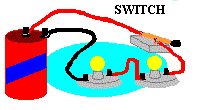
Let's look again at our series circuit. We saw
that there is only one path for the current to take. All current must be the same throughout the circuit. There is a fundamental Law of physics which covers this. |
|
In other words, no matter where you measure the current in a series circuit it will always be the same.
We also noticed that each of the lights was dimmer than just the single bulb was when we
connected two bulbs in series. Another law covers that as well.
Kirchoff's Law #2 states:
The algebraic sum of the voltage drops in any closed path in a circuit is equal to the
algebraic sum of the electromotive forces in that path.
|
Now are you confused? Maybe I can help....
We started out with a single battery. It supplies 1.5 Volts of electricity,
|

|
But when we add the second light bulb in a series circuit, the voltage must be divided between them.
Did I hear someone ask about the switch? Well, if the switch is closed, its resistance is almost zero.
If we assume the two bulbs are the same type, each bulb will drop half of the available voltage. In this
case each drops .75 Volts. And since this is only half as much voltage as the single bulb, each will
be dimmer. When we add the voltages across each bulb, .75 + .75 it equals 1.5 Volts, the same as the
voltage (electromotive force) supplied from the battery. Thus Kirchoff's Law is satisfied.
This means it does not drop any voltage across it, so it can be ignored when we calculate the drops.
|
|
And finally, a little thought exercise... If we connect a
second 1.5 Volt battery in series with the other one, the voltage will be 3 volts. Using Kirchoff's Law, compare the brightness of the two bulbs to what a single bulb would be using just one battery. |