
|
|
|
Back to Previous Page |
|
We have made our bulb light, and that was a start. But
it is a lot of trouble to disconnect the battery every time we we want to turn it off. There is a better way.
We use a SWITCH. That is an electrical device that will
|
|
Remember how the electricity needs a complete circuit
from the battery, to the bulb, then back to the battery to work? Well, if we interrupt that circuit, the current will stop flowing and the bulb will go off. That is what the switch does.
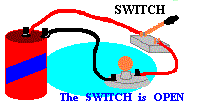
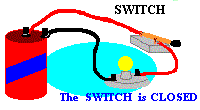
You can see how to connect the switch in this drawing.
Notice that when the switch is OPEN, the light is OFF.
That is how a switch controls the flow of electricity. |
|
|
Now suppose we wanted to add another light.
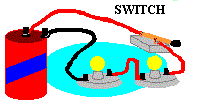
We might do it like the drawing on the left shows, by placing it in the circuit like this.
But if we do it this way, we find that each light is only
Try it for yourself; Add another bulb to your circuit. |
|
Click the Wizard for more about SERIES CIRCUITS |
Look again at how this circuit works.
The electric current flows from the battery, through the wires, to
When all the current flows through the same path, it is said to be
|
On the next page we'll look at a circuit with two lights and find another kind of circuit
where one light can be turned off while the other remains lit.